

Key Takeaways (TL;DR)
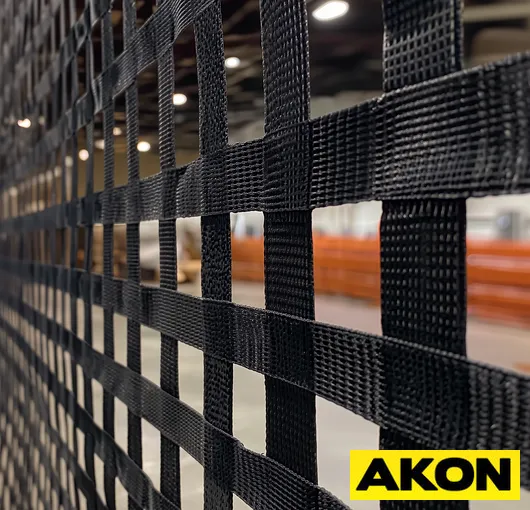
- Robotic cell guarding creates a physical perimeter around automated machinery to prevent worker contact with moving robots, welding arcs, and ejected parts.
- OSHA 1910.212 requires employers to guard every machine where workers could contact moving parts. Industrial barrier netting is one of the most practical containment options for large robotic cells and automated work zones.
- Safety netting absorbs impact energy from ejected parts without damaging the robot or the barrier, making it a flexible, cost-effective alternative to rigid steel cages.
- We supply robotic cell netting rated from 100 lbs to 2,500 lbs of impact force, with custom sizing for cells from 6 ft to 60 ft wide.
Updated: April 2026
How Does Robotic Cell Guarding Protect Workers in Automated Plants?
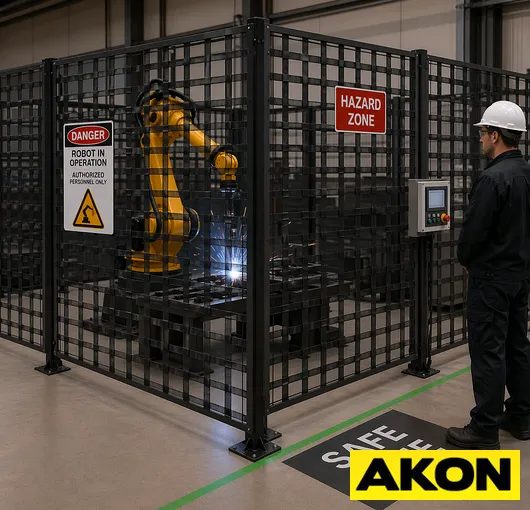
Robotic cell guarding creates a physical barrier between automated machinery and the workers who operate, program, or walk near it.
Industrial robots move fast and with enormous force. A six-axis welding robot can swing its arm at over 6 feet per second and exert hundreds of pounds of force at the tool tip. Workers who enter an unguarded cell during a cycle face crush injuries, burns from welding arcs, and impact from ejected parts. OSHA 1910.212 requires employers to guard every machine with parts that could contact a worker.
Safety netting installed around the cell perimeter stops unauthorized entry and contains anything the robot throws. Unlike rigid steel cages, netting absorbs impact energy by flexing on contact. A heavy blank or casting that hits the net decelerates over several inches instead of slamming into a hard wall. This protects the part, the robot, and the barrier itself from permanent damage.
"We replaced steel cage panels on three robotic welding cells with safety netting last year. In the first six months, the net caught two ejected blanks that would have dented our old steel panels and forced a maintenance shutdown. The netting bounced back with zero damage. We saved roughly $4,200 in panel replacement costs alone."
- Mark Hadley, Plant Manager, Summit Precision Manufacturing
Every robotic cell guarding system we supply is sized to the cell footprint, robot reach envelope, and part-ejection risk profile. We account for the maximum throw distance, part weight, and robot speed to specify the correct netting grade, mesh opening, and mounting method.
Compliance with OSHA 29 CFR 1910.212 is built into every installation. The barrier must prevent any part of a worker's body from reaching the hazard zone, and it must contain any object the machine could eject during normal or fault conditions. Our netting systems are rated and tested to meet both criteria.
Which Guarding Configuration Does Your Robotic Cell Need?
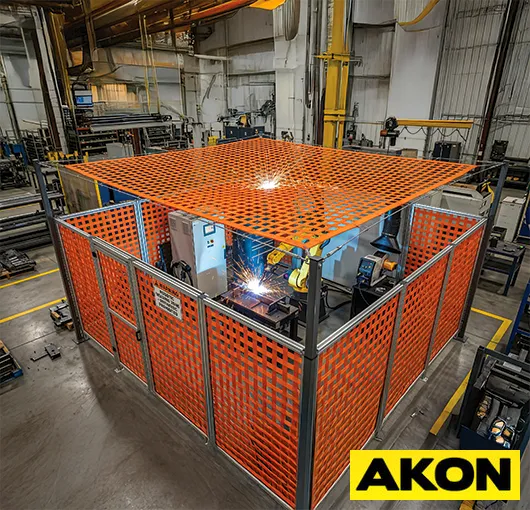
Robotic cell guarding is available in three main configurations: full-perimeter netting enclosures, partial-perimeter netting with hard-wall hybrid sections, and overhead netting canopies for arc containment.
Full-perimeter netting is the standard choice for stand-alone robotic cells. The net runs on steel cable between floor-mounted stanchions and encloses all four sides of the cell. Access doors with interlock switches let operators enter safely during programming and maintenance cycles.
Partial-perimeter (hybrid) systems combine netting on the open sides of a cell with existing hard walls, columns, or adjacent machine frames. This approach cuts material cost by 30% to 50% because you only net the exposed faces.
Overhead canopy netting is specified for robotic welding cells and grinding stations where sparks, spatter, and small parts can be thrown upward or outward at steep angles. The canopy nets across the top of the cell and catches anything the vertical perimeter nets would miss.
Safety Netting vs Steel Cages vs Light Curtains: Side-by-Side Comparison
| Feature | Safety Netting | Steel Cages | Light Curtains |
|---|---|---|---|
| Ejected Part Containment | ✓ Absorbs impact | ✓ Deflects impact | ✗ No physical barrier |
| Impact Damage to Barrier | ✓ Self-recovers | ✗ Dents / warps | N/A |
| Reconfiguration Speed | ✓ 30 - 60 min | ✗ Days (cut / weld) | ✓ 1 - 2 hours |
| Spark / Spatter Containment | ✓ FR netting avail. | ✓ Inherent (steel) | ✗ No containment |
| Visibility Into Cell | ✓ High (open mesh) | Partial (windows) | ✓ Full (no barrier) |
| Typical Cost (per sq ft) | $6 - $18 | $20 - $45 | $50 - $120 per ft |
| Overhead / Canopy Option | ✓ Net canopy | ✓ Steel roof panel | ✗ Not available |
| Interlocked Access Gate | ✓ Swing / slide / roll | ✓ Swing / slide | N/A (beam break) |
OSHA-Compliant Machine Guarding for Every Robotic Cell
Why Choose Safety Netting Over Permanent Steel Cages for Robotic Cells?
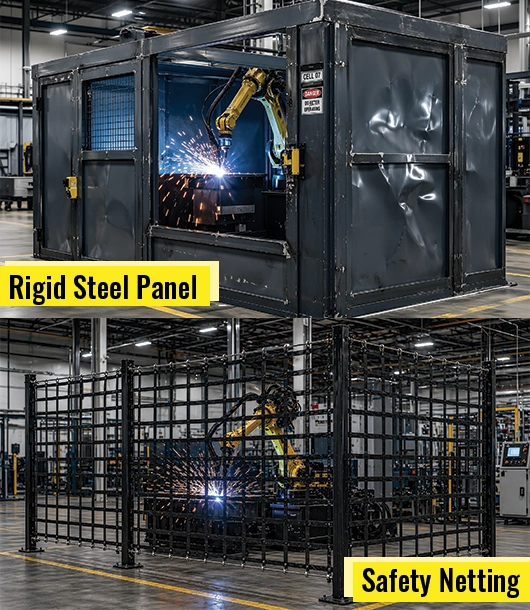
Steel cages are rigid, heavy, and expensive to modify every time a cell layout changes. Safety netting offers the same containment at a fraction of the cost, weight, and reconfiguration time.
OSHA 1910.212 requires machine guarding but does not mandate a specific material. Steel, polycarbonate, mesh, and netting all qualify as long as the barrier prevents worker contact and contains ejected objects. Netting meets both requirements while adding a critical advantage: energy absorption.
A rigid steel panel transfers the full force of an impact back into its mounting hardware. Over time, repeated hits warp the panel, crack welds, and loosen anchor bolts. Netting distributes the same force across the entire panel surface and its cable perimeter. The OSHA machine guarding guidelines emphasize that guarding must remain in place and functional; a net that self-recovers after each impact stays functional far longer than a dented steel panel.
"In our experience, the biggest cost of steel cage guarding is not the initial build. It is the ongoing cost of removing, cutting, re-welding, and reinstalling panels every time a customer reconfigures a cell. Netting eliminates that cycle entirely."
- Scott Fullerton, Operations Manager, AKON Curtains
Netting Materials for Robotic Cell Environments
High-tenacity polyester is the default netting material for most robotic cells, but Kevlar-blend, wire-reinforced, and fire-retardant options cover high-energy and high-heat environments.
High-tenacity polyester netting handles impact loads from 100 lbs to 1,500 lbs and resists UV, oil, and coolant exposure. It is the most cost-effective option for general assembly, palletizing, and material handling robots.
Kevlar-blend netting is specified for cells where heavy castings, forgings, or steel blanks could be ejected at high speed. These nets absorb impacts up to 2,500 lbs without tearing. Wire-reinforced polyester is an intermediate option for CNC lathes and milling centers that throw smaller but sharp metal chips.
Fire-retardant netting (rated to NFPA 701) is required around robotic welding cells, plasma cutting stations, and any cell producing open flame, sparks, or molten spatter. FR netting self-extinguishes on contact and does not propagate flame.

Mounting Hardware and Access Options
Floor-mounted stanchions, ceiling-hung cable systems, and bolt-on frame brackets give you three ways to mount robotic cell netting to match your floor plan and overhead clearance.
Floor stanchions are the most common mounting method. Steel posts bolt to the concrete floor on 8 ft to 12 ft centers, with steel cable strung between them at the top and bottom. The netting attaches to the cable with snap hooks or hog rings. Stanchion height ranges from 6 ft to 20 ft.
Ceiling-hung systems use turnbuckle cables anchored to roof structure or overhead crane rails. The netting drops vertically from ceiling level to a weighted bottom cable at floor height. This approach keeps the floor completely clear for forklift traffic and cell access.
Every perimeter includes at least one interlocked access gate. The gate ties into the robot controller so the cell cannot cycle while the gate is open. Sliding gates, swing gates, and roll-up netting curtain gates are available depending on the opening width and traffic pattern.
Frequently Asked Questions About Robotic Cell Guarding and Safety Netting
What is robotic cell guarding?
Robotic cell guarding is a physical barrier system installed around automated machinery to prevent workers from entering the hazard zone during operation. It also contains parts, sparks, or debris ejected by the robot. Common barrier types include safety netting, steel cages, and polycarbonate panels.
Does OSHA require guarding on robotic cells?
Yes. OSHA 1910.212 requires employers to guard every machine with moving parts that could contact a worker. Robotic cells fall under this standard. The guard must prevent body contact with the hazard and contain any objects the machine could eject.
Can safety netting stop an ejected part from a robot?
Yes. Standard polyester netting absorbs impacts up to 1,500 lbs. Kevlar-blend netting handles impacts up to 2,500 lbs. The netting flexes on contact to decelerate the part over several inches, reducing peak force on the mounting hardware.
How does netting compare to steel cages for robotic cells?
Netting costs 40% to 60% less than steel cages, weighs less, and absorbs impact without permanent damage. Steel cages are more rigid and offer better visibility through polycarbonate windows, but they warp from repeated impacts and cost more to reconfigure.
Is fire-retardant netting available for welding cells?
Yes. Fire-retardant netting rated to NFPA 701 is available for robotic welding, plasma cutting, and grinding cells. FR netting self-extinguishes on contact with sparks or molten spatter and does not propagate flame.
How long does it take to install robotic cell netting?
A typical single-robot cell (12 ft by 12 ft) installs in 4 to 6 hours with a two-person crew. Multi-cell production lines with 10 or more stations typically complete in 2 to 3 days.
Can netting be moved when the cell layout changes?
Yes. Netting panels detach from stanchion cables with snap hooks and reposition in 30 to 60 minutes. Stanchions unbolt from the floor and re-anchor at new locations. No cutting, welding, or panel fabrication is required.
How much does robotic cell guarding netting cost?
Installed costs range from $6 to $18 per square foot depending on netting grade (polyester, Kevlar-blend, or FR), height, mounting method, and access gate requirements. Steel cage guarding typically costs $20 to $45 per square foot for comparison.
Robotic Cell Guarding Options at a Glance
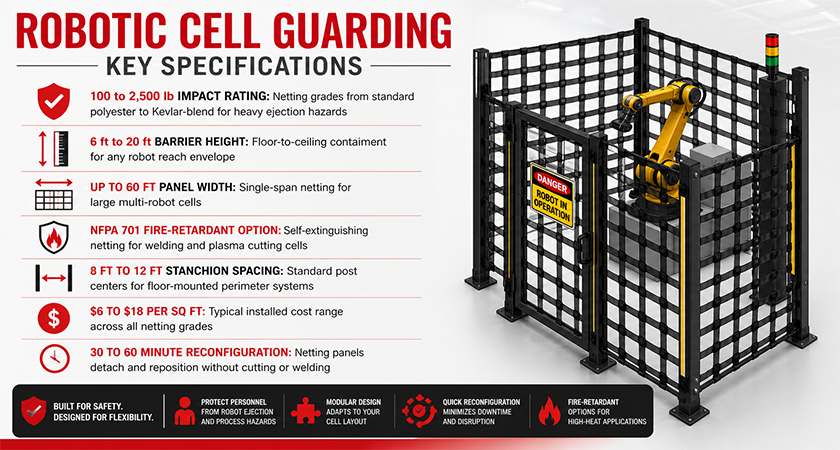
Key Specifications
- 100 to 2,500 lb impact rating: Netting grades from standard polyester to Kevlar-blend for heavy ejection hazards
- 6 ft to 20 ft barrier height: Floor-to-ceiling containment for any robot reach envelope
- Up to 60 ft panel width: Single-span netting for large multi-robot cells
- NFPA 701 fire-retardant option: Self-extinguishing netting for welding and plasma cutting cells
- 8 ft to 12 ft stanchion spacing: Standard post centers for floor-mounted perimeter systems
- $6 to $18 per sq ft: Typical installed cost range across all netting grades
- 30 to 60 minute reconfiguration: Netting panels detach and reposition without cutting or welding
How Robotic Cell Guarding Keeps Workers Safe in Automated Plants
Ejected Part Containment
Catches heavy blanks, castings, and weld spatter before they reach workers outside the cell perimeter.
Custom Cell Sizing
Netting panels supplied in heights from 6 ft to 20 ft and widths up to 60 ft to enclose any cell layout.
OSHA 1910.212 Compliant
Meets general machine guarding requirements for robotic cells, CNC enclosures, and automated welding stations.
Impact Absorption
Netting flexes on contact to absorb ejected parts without permanent deformation to the barrier or the robot.
Fast Reconfiguration
Netting panels detach and reposition in minutes when cell layouts change, unlike welded steel cages.
Conclusion
OSHA 1910.212 is clear: every robotic cell, CNC enclosure, and automated work station must have guarding that prevents worker contact and contains ejected parts. Steel cages satisfy the rule, but they are expensive to install, costly to modify, and prone to permanent damage from repeated impacts. Safety netting delivers the same protection with the added benefit of energy absorption, fast reconfiguration, and significantly lower lifecycle cost.
Whether your plant runs a single robotic welding cell or a 20-station automated line, the right netting system keeps workers safe on the outside and keeps parts contained on the inside. Custom sizing, multiple material grades, and flexible mounting options mean every installation fits the specific cell layout and hazard profile.
Build Online Now
Contains: BlogPosting + FAQPage + Organization JSON-LD.
Visible in editor only. Do not duplicate or edit manually.
About the Author
Scott Fullerton is the Operations Manager at AKON Curtains. With over 15 years of experience in industrial curtain and cover solutions, Scott oversees product development, technical specifications, and digital operations across US, UK, and European markets. He ensures customers get accurate, practical guidance on selecting the right products for their facilities. Connect with Scott on LinkedIn