
Key Takeaways (TL;DR)
- Dock safety netting prevents personnel falls from open dock doors, satisfying OSHA 29 CFR 1910.23 fall protection requirements for elevations of 4 feet or more in general industry workplaces.
- The 300 lb rated nets (tested to 600 lbs) use 1 inch polyester webbing in an 8 inch mesh pattern, mounted on welded steel stanchions with snap hooks for rapid deployment and removal.
- For facilities that also need to stop forklifts, a separate loading dock safety net rated at 13,500 lbs (forklift at 5 MPH) provides heavy-duty impact containment using elastic webbing that absorbs force without bending or breaking.
- Both net types install without specialized crews, require zero ongoing maintenance, and feature replaceable individual components rather than full-system replacement after an impact.
Updated: April 2026
Falls from loading docks are among the most common and most preventable serious injuries in warehouse and distribution operations. OSHA 29 CFR 1910.23 requires fall protection at elevations of 4 feet or more in general industry settings, and an open dock door with a 4 to 5 foot drop to grade level falls squarely within that requirement. We supply loading dock safety nets that satisfy this standard with a lightweight, high-visibility barrier that installs in minutes and stows completely out of the way when the dock is in use.
Across our work with US warehouse operators, 3PL providers, and distribution centers, we see two distinct dock netting requirements. The first is personnel fall protection — keeping people, hand carts, and light pallet trucks from going over the edge. The second is forklift containment — stopping a loaded forklift that approaches the dock edge at operating speed. These are fundamentally different load cases, and they require different products.
How Does Dock Safety Netting Prevent Falls at Open Dock Doors?
Dock safety netting creates a continuous physical barrier across open dock door openings that prevents workers, hand carts, and light pallet trucks from falling off the dock edge, satisfying OSHA's requirement for guardrails or equivalent barriers at 4-foot elevations.
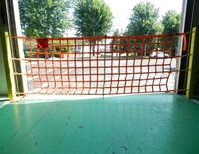
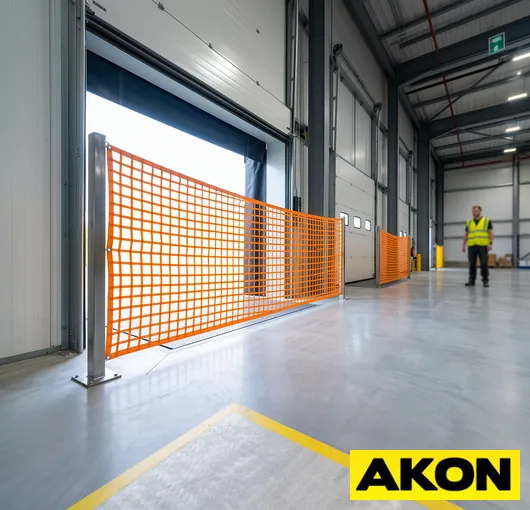
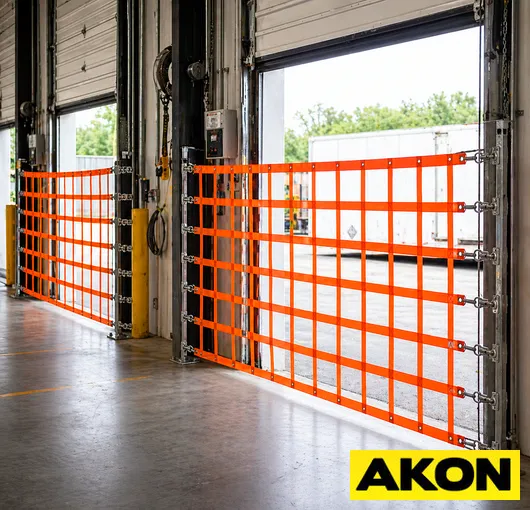
The net attaches to welded steel stanchions using adjustable snap hooks and web straps. Stanchions are anchored to the dock floor on either side of the door opening, and eye bolts on shared center stanchions allow a single post to serve two adjacent dock doors. This means you can protect an entire row of dock bays without doubling up on hardware between doors.
The 1 inch polyester webbing is configured in an 8 inch on-center mesh pattern that provides high visibility while allowing airflow and light through the barrier. The net itself is rated at 300 lbs (tested to 600 lbs), which exceeds the multi-directional load requirement for fall protection barriers under OSHA 29 CFR 1910.23.
The regulatory basis is straightforward. OSHA 29 CFR 1910.23 requires that walking-working surfaces with an unprotected edge 4 feet or more above a lower level must be guarded by a railing, fence, half-door, or equivalent barrier at least 42 inches high. Dock safety netting meets this height requirement when properly installed and provides the multi-directional 300 lb load resistance specified for top rails and anchor points.
Unlike chain barriers or retractable belt stanchions, netting provides a full-coverage physical barrier that cannot be stepped over, ducked under, or easily bypassed. It is also far less expensive than permanent steel railings and can be removed in seconds when a trailer backs into the dock for loading.
"We had three near-miss incidents at open dock doors in one quarter before we installed netting across all twelve bays. The nets went up in half a day with two guys, cost us $9,200 total, and we have not had a single dock-edge incident in the fourteen months since. The stanchion system lets us unhook one side and swing the net clear in about ten seconds when a truck arrives."
— Dana Whitfield, Warehouse Operations Manager, CrossPoint Logistics LLC

When Do You Need Forklift-Rated Dock Safety Nets Instead?
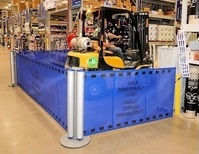
When the hazard is a loaded forklift approaching the dock edge at operating speed, a 300 lb personnel net is not sufficient. You need a 13,500 lb rated dock safety net engineered to absorb and distribute the kinetic energy of a forklift impact.
The heavy-duty dock safety nets use elastic polyester webbing that absorbs impact force rather than resisting it rigidly. This is the critical difference from conventional steel barriers: a steel rail bends or breaks on impact, and the entire system needs replacement. A net barrier flexes, distributes the load across its full span, and typically sustains minimal to no damage from moderate impacts.
Even after a significant collision, individual net components (webbing panels, post sleeves, hardware) can be inspected and replaced individually. You do not need to replace the entire system. This makes the total cost of ownership significantly lower than steel barrier alternatives that require full replacement after any meaningful impact.
Personnel Nets vs Forklift Nets vs Steel Barriers
| Feature | Personnel Net (300 lb) | Forklift Net (13,500 lb) | Steel Barrier |
|---|---|---|---|
| Load Rating | 300 lbs (tested 600) | 13,500 lbs at 5 MPH | Varies by spec |
| Personnel Fall Protection | ✓ | ✓ | ✓ |
| Forklift Containment | ✗ | ✓ | ✓ (bends on impact) |
| Impact Absorption | Elastic webbing | Elastic webbing ✓ | Rigid ✗ |
| Post-Impact Repair | Replace net panel only | Replace net panel only ✓ | Replace full system ✗ |
| Specialized Installation | No ✓ | No ✓ | Yes (welding) ✗ |
| Ongoing Maintenance | Zero ✓ | Zero ✓ | Repaint, re-weld |
| OSHA 1910.23 Compliant | ✓ | ✓ | ✓ |
Protecting Your Dock Operations with Compliant Safety Netting

Why Choose Netting Over Steel Barriers or Chain Guards?
Dock safety netting delivers equivalent or superior fall protection at lower cost than steel railings, installs without welding or specialized labor, and requires zero ongoing maintenance, while providing full-area coverage that chains, belts, and half-doors cannot match.
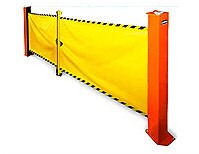
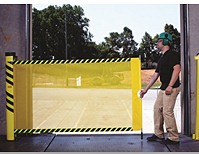
Steel dock barriers are effective but expensive, permanent, and vulnerable to damage. A single forklift bump bends a steel crossbar beyond use, and replacing even one section often means an on-site welder and a full day of downtime. Dock netting absorbs those same impacts without damage in most cases, and individual components swap out in minutes if inspection reveals wear.
Chain guards and retractable belt barriers are inexpensive but provide only visual deterrence. They do not meet the 300 lb load resistance requirement for fall protection barriers under OSHA 1910.23, and they cannot physically prevent a person or hand cart from going over the edge. Netting fills the gap between these extremes: it is a true physical barrier at a fraction of the cost of steel.
Installation and Deployment in Minutes
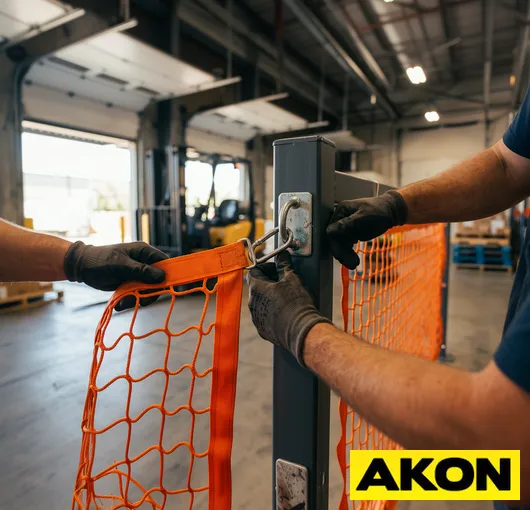
Dock safety nets mount to floor-anchored stanchions and deploy or stow using snap hooks. No specialized tools, no on-site professionals, and no modifications to the dock door or building structure.
Each net ships with welded steel stanchions painted in a high-visibility color for additional safety marking. The stanchions bolt to the dock floor on either side of the opening, and the net clips on with heavy-duty snap hooks. To clear the opening for a trailer, unhook one side and swing the net to the opposite stanchion. The entire process takes about ten seconds.
For wide dock door configurations, nets are available in spans up to 32 feet. Openings wider than 20 feet require an anchored center bollard for additional support. Custom sizes are available for non-standard dock configurations, and the nets ship within 7 to 10 business days via UPS or FedEx.
Maintenance, Durability, and Replacement
After installation, dock safety nets require zero scheduled maintenance. The polyester webbing resists UV degradation, moisture, and chemical exposure, and the entire system carries a lifetime warranty on manufacturing defects.
Unlike steel barriers that bend permanently after impact, the elastic properties of polyester webbing allow the net to absorb and redistribute force without sustaining structural damage in most contact events. After any impact, inspect the net per your facility's safety standards. If a section shows wear, order a replacement net panel, not the entire system.
This component-level repairability is one of the strongest cost arguments for netting over steel. A bent steel railing costs $2,000 to $4,000 to replace including labor. A replacement net panel for the same span costs a fraction of that and installs in minutes without a welder.
Frequently Asked Questions about Dock Safety Netting for Warehouses and Distribution Centers
What OSHA standard requires dock safety netting?
OSHA 29 CFR 1910.23 requires fall protection at walking-working surfaces with unprotected edges 4 feet or more above a lower level. Open loading dock doors with a 4 to 5 foot drop to grade fall within this requirement.
What is the load rating for personnel dock safety nets?
Personnel dock safety nets are rated at 300 lbs and tested to 600 lbs. This exceeds the multi-directional load resistance requirement for fall protection barriers under OSHA 1910.23.
Can dock safety netting stop a forklift?
Standard 300 lb personnel nets cannot stop a forklift. For forklift containment, a 13,500 lb rated dock safety net (tested at forklift speed of 5 MPH) is required.
How long does it take to install dock safety netting?
Most dock netting systems install in under one day with a two-person crew using basic tools. Stanchions bolt to the dock floor, and nets attach with snap hooks.
What is the maximum span for dock safety netting?
Dock safety nets are available in spans up to 32 feet. Openings wider than 20 feet require an anchored center bollard for intermediate support.
How do you clear the net for trailer loading?
Unhook the snap hooks on one side and swing the net to the opposite stanchion. The entire process takes approximately ten seconds.
What maintenance does dock safety netting require?
Zero scheduled maintenance. The polyester webbing resists UV, moisture, and chemical exposure. Inspect nets after any impact event. Replacement panels are available individually.
Do dock safety nets come with a warranty?
Yes. All dock safety nets carry a lifetime warranty on manufacturing defects. Nets ship within 7 to 10 business days via UPS or FedEx.
Dock Safety Netting Specifications at a Glance

Key Specifications
- Personnel net rating: 300 lbs (tested to 600 lbs)
- Forklift net rating: 13,500 lbs at 5 MPH
- Webbing material: 1 inch polyester, 8 inch OC mesh
- Maximum span: 32 feet (center bollard over 20 ft)
- OSHA compliance: 29 CFR 1910.23 fall protection
- Warranty: lifetime on manufacturing defects
Why Dock Operations Choose Safety Netting
Zero Maintenance
UV-resistant polyester webbing. Lifetime warranty on manufacturing defects.
Rapid Deployment
Snap hooks and stanchions allow ten-second deployment or stowing. No tools required.
Fall Protection
300 lb rated nets (tested to 600 lbs) prevent personnel falls from open dock doors at 4+ foot elevations.
OSHA Compliant
Satisfies OSHA 29 CFR 1910.23 requirements including 42 inch height and 300 lb load resistance.
Forklift Rated
Heavy-duty 13,500 lb model stops forklifts at 5 MPH using elastic impact-absorbing webbing.
Conclusion
Open dock doors with a 4 to 5 foot drop to grade represent one of the most common fall hazards in warehouse operations, and OSHA 29 CFR 1910.23 requires a physical barrier. Dock safety netting meets that requirement with a 300 lb rated (600 lb tested) barrier that installs in minutes, stows in seconds, and requires zero maintenance.
For operations where forklift containment is also a concern, 13,500 lb rated nets provide impact absorption that steel barriers cannot match, with individual component replacement instead of full-system teardown after a collision. If your facility needs dock fall protection that works without compromise, our netting systems are custom-sized to your exact door openings.
Need Dock Saftey Netting For Your Facility?
Contains: BlogPosting + FAQPage + Organization JSON-LD.
Visible in editor only.
About the Author
Scott Fullerton is the Operations Manager at AKON Curtains. With over 15 years of experience in industrial curtain and cover solutions, Scott oversees product development, technical specifications, and digital operations across US, UK, and European markets. He ensures customers get accurate, practical guidance on selecting the right products for their facilities. Connect with Scott on LinkedIn.