

Key Takeaways (TL;DR)
- Mezzanine safety barriers prevent falls, dropped tools, and material spills from elevated platforms, catwalks, and mezzanine edges in warehouses and manufacturing plants.
- OSHA 1910.29 requires guardrails at 42 inches (plus or minus 3 inches) with 200 lb top-rail load capacity on every open-sided platform 4 feet or higher. Warehouse barrier netting is one of the most effective secondary containment options to pair with guardrails.
- Custom mesh, net, and panel barrier systems reduce falling-object injuries by up to 90% when installed alongside compliant guardrails and toeboards.
- We supply barriers in heights from 4 ft to 20 ft, with fire-retardant, anti-static, and heavy-duty mesh options to match your facility's specific hazards.
Updated: April 2026
How Do Mezzanine Safety Barriers Prevent Workplace Injuries?
Mezzanine safety barriers stop workers from falling off open-sided platforms and prevent tools, parts, and materials from dropping onto personnel below.
Falls from elevation are the second leading cause of workplace fatalities in general industry, according to OSHA. A mezzanine with no secondary barrier beyond a standard guardrail still allows small objects to slide under the rail or through gaps. Safety barriers close those gaps.
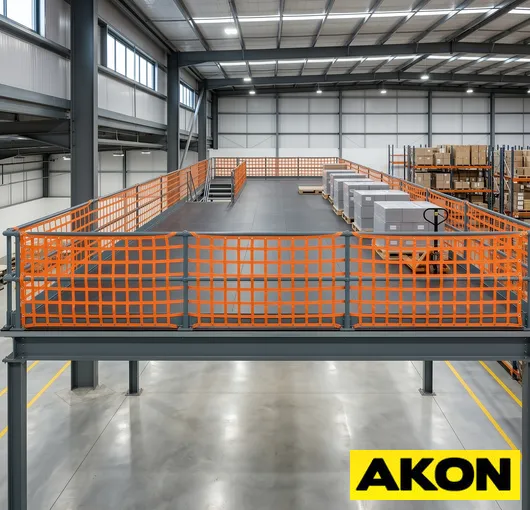
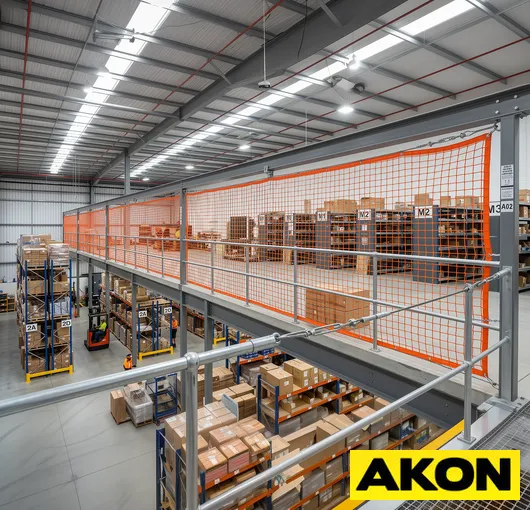
Mesh barriers, net systems, and solid panel barriers attach directly to existing guardrail posts or mezzanine columns. They create a continuous wall of containment from the toeboard up to 10 ft or higher, depending on what your facility stores or handles at elevation.
"We had two near-miss incidents in six months where boxed parts slid off our pick module mezzanine. After installing mesh safety barriers across all 340 ft of open edge, we have not had a single dropped-object report in over 14 months."
- James Whitfield, Warehouse Operations Manager, Ridgepoint Logistics Ltd
Every mezzanine barrier we supply is custom-sized to the platform layout. We take into consideration the edge profile, load type, and operating environment to specify the correct barrier material, attachment method, and height. This is not a generic safety product. Each barrier system is configured for the specific mezzanine it protects.
Compliance with OSHA 29 CFR 1910.29 is built into every installation. Top rails meet the 42-inch height standard with 200 lb load capacity, and toeboards satisfy the 3.5-inch minimum. Our barrier infill (mesh, net, or panel) closes the mid-zone gap that standard guardrails leave exposed.
Which Barrier Type Does Your Mezzanine Need?
Mezzanine safety barriers are available in three main configurations: wire mesh panels, safety netting, and solid polycarbonate or steel panels, each suited to different hazard profiles and budgets.

Wire mesh panels are the most common choice for warehouse mezzanines. They provide excellent visibility, allow airflow for HVAC and fire suppression systems, and contain objects down to approximately 2-inch diameter. Standard mesh gauges range from 10-gauge to 6-gauge wire, with heavier gauges suited to areas with heavy pallet loads.

Safety netting is ideal for large open spans, irregular edge profiles, and areas where rigid panels are difficult to mount. Netting installs with cable and turnbuckle hardware and can span up to 50 ft between anchor points. It is the lightest option and often the fastest to install.

Solid panels (polycarbonate, steel, or aluminum) provide total containment for dust, liquid spills, and fine particles. These are specified for mezzanines above food processing lines, pharmaceutical areas, and cleanrooms where even small debris is unacceptable.
Mesh Barriers vs Panel Barriers vs Netting Systems: Side-by-Side Comparison
| Feature | Wire Mesh Panels | Safety Netting | Solid Panels |
|---|---|---|---|
| Falling Object Containment | ✓ Objects >2 inch | ✓ Objects >4 inch | ✓ Total containment |
| Airflow / Visibility | ✓ High | ✓ High | ✗ Blocked |
| Dust / Liquid Containment | ✗ No | ✗ No | ✓ Yes |
| Max Span (Unsupported) | 10 ft | 50 ft | 8 ft |
| Fire-Retardant Option | ✓ Inherent (steel) | ✓ FR netting avail. | ✓ Steel / polycarb |
| Typical Cost (per sq ft) | $12 - $20 | $8 - $15 | $18 - $25 |
| Install Speed (200 ft run) | 1 - 2 days | 0.5 - 1 day | 2 - 3 days |
| Retrofit to Existing Rails | ✓ U-bolt clamps | ✓ Cable + turnbuckle | ✓ Bracket mount |
OSHA-Compliant Fall Protection for Every Elevated Platform

Why Choose Safety Barriers Over Standard Guardrails Alone?
Standard guardrails satisfy the minimum OSHA height requirement, but they do not contain small objects, loose materials, or debris that can fall through the open space below the top rail.
OSHA 1910.29 requires a top rail at 42 inches and a toeboard at 3.5 inches, but the gap between them is unprotected unless you add a mid-rail or a barrier. In a busy warehouse, that gap is exactly where cartons, hand tools, and packaging materials escape.
Safety barriers fill the entire opening with mesh, netting, or solid panels. This is especially important on mezzanines used for order picking, parts storage, and kitting operations where small items are handled constantly. The OSHA 1910.28 duty clause places the responsibility on the employer to provide adequate fall and falling-object protection for every open-sided platform 4 feet or higher.
"In our experience, most mezzanine incidents involve objects, not people. A guardrail keeps the worker on the platform. A barrier keeps everything else up there too."
- Scott Fullerton, Operations Manager, AKON Curtains
Materials for Every Facility Environment
Galvanized steel mesh handles most standard warehouse applications, but stainless steel, powder-coated panels, and fire-retardant netting cover specialized environments from food plants to welding mezzanines.
For food and beverage facilities, 304 stainless steel mesh resists corrosion from washdowns and acidic environments. Powder-coated carbon steel panels in safety yellow provide high visibility and meet ANSI Z535 color-coding standards for physical hazards.
Fire-retardant mesh and netting (rated to NFPA 701 or ASTM E84 Class A) is required on mezzanines near welding stations, paint spray booths, and thermal processing equipment. Anti-static mesh is available for environments with combustible dust or flammable vapor exposure.

Mounting Options and Accessories
Post-mount, clamp-on, and bolt-through attachment methods let barriers connect to virtually any mezzanine rail system, column, or deck edge profile.
A post-mount bracket is the most common attachment for existing guardrail systems. U-bolt clamps secure the barrier panel to the vertical post without drilling or welding, which means installation does not compromise the structural integrity of the rail.
For mezzanines without guardrails, floor-mounted barrier posts bolt directly to the deck surface using base plates and concrete anchors. Post spacing is typically 6 ft to 10 ft on center, depending on the barrier weight and wind or impact load requirements. Self-closing safety gates, kick plates, and integrated signage are available as add-on accessories.
Frequently Asked Questions About Mezzanine Safety Barriers for Warehouses and Manufacturing
What is a mezzanine safety barrier?
A mezzanine safety barrier is a mesh, net, or solid panel system installed along the open edges of elevated platforms. It prevents workers from falling and contains objects that could drop onto personnel below. Barriers are installed in addition to standard guardrails for full OSHA compliance.
Does OSHA require barriers on mezzanines?
OSHA 1910.28 requires fall protection on every open-sided platform 4 feet or higher. Standard 1910.29 specifies guardrail criteria including a 42-inch top rail and 3.5-inch toeboard. Barriers close the unprotected mid-zone gap between these two elements.
What types of mezzanine barriers are available?
The three main types are wire mesh panels (best for warehouses), safety netting (best for wide spans and irregular edges), and solid panels (best for cleanrooms, food plants, and dust containment). Each type is available in multiple material grades.
How tall should a mezzanine safety barrier be?
Barriers typically range from 4 ft to 20 ft above the platform deck. The minimum effective height is 42 inches (matching the OSHA guardrail standard), but taller barriers are recommended for mezzanines storing stacked pallets or handling lightweight materials that can be blown by HVAC airflow.
Can barriers be added to existing guardrails?
Yes. U-bolt clamps and post-mount brackets allow mesh panels and netting to attach directly to existing guardrail posts without welding or drilling. This preserves the rail's structural rating and reduces installation time to hours rather than days.
Are fire-retardant barrier materials available?
Yes. Fire-retardant mesh and netting rated to NFPA 701 or ASTM E84 Class A is available for mezzanines near welding stations, paint booths, and thermal processing areas. Anti-static mesh is also supplied for facilities with combustible dust hazards.
How much do mezzanine safety barriers cost?
Costs range from approximately $8 to $25 per square foot depending on material (mesh, netting, or solid panel), gauge, finish, and mounting hardware. Custom sizing, fire-retardant ratings, and stainless steel construction increase the price. We provide free quotes for every project.
How long does installation take?
A typical 200 ft mezzanine perimeter with mesh panel barriers installs in 1 to 2 days using clamp-on mounting hardware. Netting systems covering the same span can often be completed in a single day. Solid panel systems take slightly longer due to individual panel alignment.
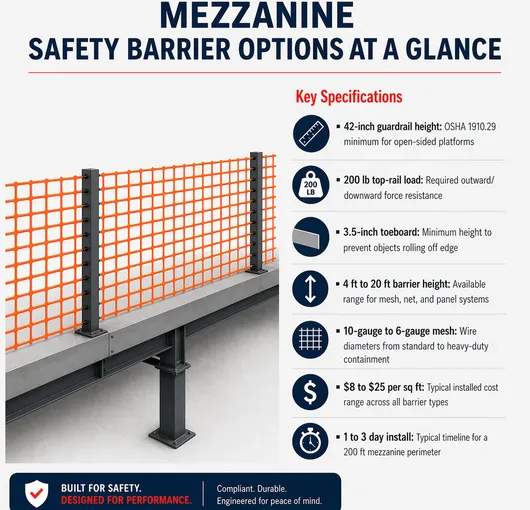
Mezzanine Safety Barrier Options at a Glance
Key Specifications
- 42-inch guardrail height: OSHA 1910.29 minimum for open-sided platforms
- 200 lb top-rail load: Required outward/downward force resistance
- 3.5-inch toeboard: Minimum height to prevent objects rolling off edge
- 4 ft to 20 ft barrier height: Available range for mesh, net, and panel systems
- 10-gauge to 6-gauge mesh: Wire diameters from standard to heavy-duty containment
- $8 to $25 per sq ft: Typical installed cost range across all barrier types
- 1 to 3 day install: Typical timeline for a 200 ft mezzanine perimeter
Why Facility Managers Specify Mezzanine Safety Barriers
Falling Object Protection
Mesh and net barriers contain dropped tools, boxes, and debris before they reach workers below.
Custom Sizing
Barriers supplied in heights from 4 ft to 20 ft and widths up to 100 ft to fit any mezzanine layout.
OSHA 1910.29 Compliant
Meets guardrail height, load, and toeboard requirements for elevated platforms 4 feet and above.
Fall Prevention
Barriers keep workers and materials safely contained on mezzanines, catwalks, and raised storage platforms.
Fire-Retardant Options
FR-rated mesh and panel barriers available for welding mezzanines, paint booths, and hot-work areas.
Conclusion
OSHA 1910.28 and 1910.29 are clear: every open-sided mezzanine, platform, and catwalk 4 feet or higher must have compliant fall protection. Standard guardrails satisfy the minimum rule, but they leave a wide gap between the top rail and the toeboard where objects (and sometimes people) can slip through. Mezzanine safety barriers close that gap completely.
Whether your facility needs wire mesh panels for a pick-module mezzanine, safety netting across a wide conveyor opening, or solid panels above a food processing line, the right barrier system protects workers on the platform and everyone below it. Custom sizing, material selection, and mounting flexibility mean every installation fits the specific layout and hazard profile of your elevated space.
Build Online Now
Contains: BlogPosting + FAQPage + Organization JSON-LD.
Visible in editor only. Do not duplicate or edit manually.
About the Author
Scott Fullerton is the Operations Manager at AKON Curtains. With over 15 years of experience in industrial curtain and cover solutions, Scott oversees product development, technical specifications, and digital operations across US, UK, and European markets. He ensures customers get accurate, practical guidance on selecting the right products for their facilities. Connect with Scott on LinkedIn